
Found total of 20 items and showing 8 items on page 2 of 2
Modelling the COVID-19 Pandemic


Research Software Engineers, Peter Crowther and Ann Gledson, have been working with the University Department of Mathematics and the London School of Hygiene and Tropical Medicine on improving their simulation model of contact tracing, which can be used to predict and explain the effectiveness of different strategies in reducing the spread of SARS-CoV-2
Making a Difference Award for Manchester Urban Observatory

Ann Gledson, Research Software Engineer, is part of a cross-university team that recently won a University of Manchester “Making a Difference” award for the Manchester Urban Observatory.
Turning Analysis Scripts into Packages


Find out how Peter Crowther, a Research Software Engineer in Research IT, helped Christopher Daniel from the Lightform Group in the Department of Materials to improve and prepare his code ready for publication.
How Should We Deduce the Tree of Life?

Working out the relationships between the twigs in the tree of life - with confidence - is a key goal for biologists and palaeontologists. It also provides computational challenges. Russell Garwood, from the School of Natural Sciences, explains what these are, and how Research IT have helped.
Citizen Sensors in Brazil


Imagine if you could gather data from thousands of mobile data points reacting to the environment around them? That's what our Research Software Engineers have been helping to do and in more than one language thanks to an international collaboration!
Hair Rendering at the Research IT Data Vis Lab

Girish Ramesh from the Textiles and Apparel Group in the School of Materials was one of the first users of our prototype Visualization and Data Analysis Laboratory (vDAL). He used the powerful machines to visualise hair as part of his PhD and also as part of the prestigious Google Summer of Code.
Build Your Own Earth


Would you like to be able to explore climate models and visualise their output? A new web-based tool from Prof David Schultz’s research group in the School of Earth and Environmental Sciences, allows you to do just that. The research team consisting of Jonathan Fairman, Stuart Anderson, and Sharon Gardner, developed the “Build Your Own Earth” model using the computational power provided by N8 HPC, the regional computing platform accessed and supported through Research IT.
How fast can a T. rex run?
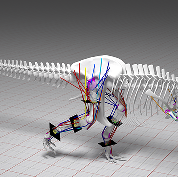
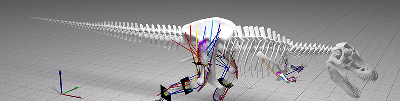
Dr William Sellers from the School of Earth and Environmental Sciences has been hitting the headlines with his discovery that Tyrannosaurus rex was unable move faster than a gentle jog, let alone run. The research looks extensively into the gait and biomechanics of the world’s most famous dinosaur and, using the external HPC resources accessed through and supported by Research IT, has created a new simulation model to test its findings.