
Found total of 52 items and showing 12 items on page 4 of 5
Autumn HPC Calls Now Open


There are two HPC calls out at the moment – one for access to the EPSRC funded Tier 2 High Performance Computing facilities and one for access to ARCHER, a Cray XC30 machine. If you are interested in responding to either of these calls, we are happy to help with any applications, please get in touch.
CSF Milestone Reached!


The popular Computational Shared Facility (CSF) has recently hit a significant milestone with the 1-millionth job being submitted.
HPC Calls now Open
There are several EPSRC HPC (high performance computing) calls out at the moment which researchers should be aware of. If you would like to apply to any of them Research IT is able to help with the preparation of applications.
CSF Reaches a Major Milestone


The Computational Shared Facility (CSF) has now officially come of age - it has reached an amazing 10,000 CPU cores - with around 4000 cores of Haswell / Broadwell and a Skylake procurement coming up in January.
Build Your Own Earth


Would you like to be able to explore climate models and visualise their output? A new web-based tool from Prof David Schultz’s research group in the School of Earth and Environmental Sciences, allows you to do just that. The research team consisting of Jonathan Fairman, Stuart Anderson, and Sharon Gardner, developed the “Build Your Own Earth” model using the computational power provided by N8 HPC, the regional computing platform accessed and supported through Research IT.
Tier-2 HPC Applications Open Now
EPSRC is offering open access to five new Tier-2 High Performance Computing facilities through a call for proposals. Free access to the facilities is through a two stage peer review process with an initial closing date of the 21st of September. There will only be three calls a year for access to the facilities.
UK HPC Skills Survey


How fast can a T. rex run?
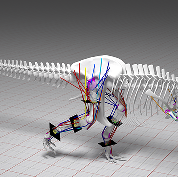

Dr William Sellers from the School of Earth and Environmental Sciences has been hitting the headlines with his discovery that Tyrannosaurus rex was unable move faster than a gentle jog, let alone run. The research looks extensively into the gait and biomechanics of the world’s most famous dinosaur and, using the external HPC resources accessed through and supported by Research IT, has created a new simulation model to test its findings.
Call for Access to the European HPC Service (PRACE)


PRACE has recently announced its 15th Call for Proposals for Project Access. The current call provides access to various European Tier 0 systems from Bull, Cray, Lenovo and IBM. These comprise a mixture of standard x86, Knights Landing and GPU platforms. Joint submissions from academia and industry are particularly welcome.
Free Access to the Computational Facility (CSF)
Our flagship computational facility, The CSF, is currently only available to those researchers contributing funds to the platform. However we are pleased to announce that our recent case to provide limited free-at-the-point-of-use computational resource to users without funds, particularly for those who are not computational specialists, has been successful.
Code Optimisation on ARCHER


Would you like to improve the performance of your applications on ARCHER?
This course on “Single Node Performance Optimisation” will cover the main features of modern HPC nodes, including multiple cores, vector floating point units, deep cache hierarchies, and NUMA memory systems.
Computing Insight UK 2016


Save the date: 14-15 December 2016Location: Manchester Central Convention Complex, Manchester, UK
STFC are lining up an exciting programme of speakers for you at CIUK 2016, ready to highlight the way high performance computing, data-centric and cognitive technologies are accelerating research, boosting business and changing the world around us.