
The C++ Users Group and the Green Compute for Research @UoM recently ran a joint meeting with the topic “Responsible Research Computing and AI-Assisted Software Development” bringing together members of the research community from across the university.
The session brought together the two groups together (along with the University AI Environmental Sustainability Working Group) to explore the environmental and practical dimensions of research software development in the AI era.
Topics included trade-offs in ML-based data compression, carbon-aware job scheduling, planned green computing training, local LLMs for coding, and emerging guidelines on AI-assisted software development. The group held this as a joint meeting to combine software development practice with sustainability expertise and discuss these intersecting issues. For more information, please visit our event page.
Presentations
We want to extend a special thank you to our brilliant speakers, whose lightning talks set the stage by connecting AI workflows with sustainable research computing:
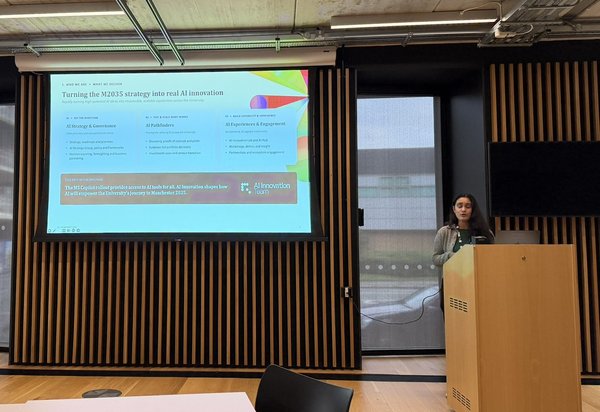
- Arushi Singh (AI Innovation Strategist, Unit M) – AI Innovation – The Unit M AI Innovation Lab
- Harry Hook – Use of LLMs for accelerating software development for high-energy physics
- Sarah Jaffa (Senior Research Software Engineer, Research IT)– The current landscape of AI training for researchers
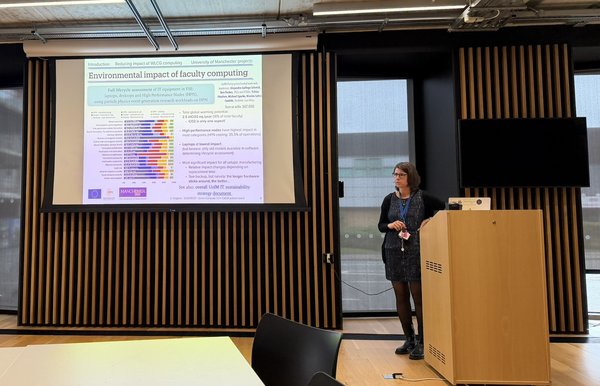
- Caterina Doglioni (Professor of Particle Physics, Particle Physics Group)– Interdisciplinary green compute activities at the University
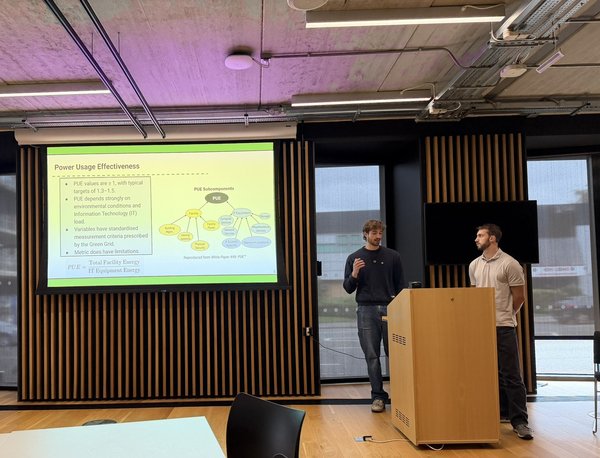
- Tom Hodgkinson and Harry Baldwin – Metrics for green computing infrastructure
- Ann Gledson (Research Software Engineer, Research IT) – Introduction to Green DiSC
Reflections on Responsible AI in Coding
It was fascinating to hear everyone's perspectives throughout the morning, particularly during the interactive session led by Michael Sparks (Senior Research Software Engineer, Particle Physics Group) and Caterina Doglioni. The discussion on the responsible use of AI in coding was genuinely eye-opening. Together, we explored the real-world trade-offs of AI-assisted development, focusing heavily on how we can ensure code quality, maintainability, and scientific rigour remain high when integrating LLMs into our daily programming workflows, alongside the environmental footprint of the compute we use.
Event Photos and Presentation Slides
If you would like to revisit any of the talks or catch up on what you missed, you can find the presentation slides and photos from the event on the C++ Users Group, CaDiR Teams space.
Looking Ahead
We hope the talks and discussions gave you helpful insights and practical ideas to take back to your own research and software projects. Thank you again to everyone who contributed questions, shared their experiences, and stayed to chat over lunch. We hope to see you at our future C++ Users Group and Green Compute for Research @ UoM events!
— The Organising Team (Andrew Gait (Research Software Engineer, Research IT), Erdem Atbas (Research Software Engineer, Research IT), Caterina Doglioni (Professor of Particle Physics, Particle Physics Group), Raymond Wan (Research Associate, Chemical Biology and Biological Chemistry),and Russell Garwood (Reader in Earth and Environmental Sciences, Academic & Research))
Computation and Data in Research (CaDiR)
Find out more about CaDiR and the special interest and user groups that fall under its scope. The groups are open to all University of Manchester staff, researchers and PGRs.