

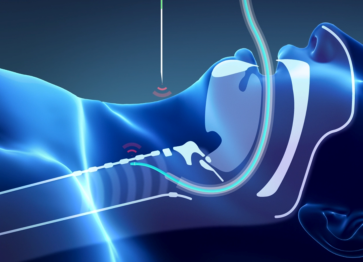
Percutaneous dilatational tracheostomy is a common procedure carried out in intensive care where a breathing tube is inserted directly into a patient's windpipe through the front of the neck. However, it can be challenging when a patient's anatomy makes it difficult for clinicians to identify the correct position. The GiFT project makes this easier by using electromagnetic tracking to provide clinicians with real-time information about the position and orientation of the tracheostomy needle and a sensor positioned in the trachea with a bronchoscope (a small camera), helping to make the procedure more accurate and safer.
As GiFT progressed, the software also needed to evolve alongside the technology. The team needed a robust, intuitive system that could bring together information from the tracking hardware and present it clearly to medical staff during a procedure.
Andrew Weightman, Professor of Medical Mechatronics at the University of Manchester contacted the Research Software Engineering (RSE) team to access our expertise to help redesign and develop the software supporting the GiFT system, making sure that industry standards were used, and that the software could run on an embedded system adequate for the medical setting.
The RSE team worked closely with the GiFT team to understand the requirements and safety concerns, as well as the way in which the clinicians would use the software. Our well developed agile methods for project tracking and development proved invaluable to continuously adjust to the projects changing needs.
Software aims and challenges
The key aspect of the software was to make sure it could communicate reliably with the tracking devices, process the information they provided, and turn it into something meaningful and accurate for the clinician. At the same time, the information needed to be recorded for further analysis.
We also had to think carefully about how a clinician would use the system during a procedure. Together with the research and clinical team, we designed a workflow that guides medical staff through the different stages of the procedure, helping ensure that the necessary checks are carried out at the appropriate points.
Another important part of the work was deciding how the tracking information should be visualised. Rather than simply displaying raw measurements, a 3D visual guidance system was conceived and introduced by the RSE team which makes it easy to understand the needle's position and whether it is within the desired area.
Safety was central to these decisions. The software includes appropriate warnings and safeguards to alert the user when something requires attention and to help prevent the procedure from progressing when important conditions have not been met.
The software was also tested outside the clinical setting, through unit and integration testing. This allowed us to make substantial changes to the software while maintaining confidence that the system continued to behave as expected.
The result was a redesigned software system that brings together the tracking technology, visual guidance and clinical workflow into a single application — helping turn the underlying research into a tool that can ultimately support medical professionals in practice.
A Word From the GiFT Team
Working with the Research IT team enabled software engineering expertise to be brought into our team that would have been incredibly difficult to source otherwise. Working with Francisco was fantastic, in addition to his expertise he bought fully into the project and provided lots is useful input to shape the direction, improving outcomes.
Working closely with the Research IT team on the GIFT project has been a hugely valuable experience. Collaborating with our software engineering colleagues has given me the opportunity to develop my programming skills and learn valuable software development processes, including version control, testing and documentation. At the same time, our collaboration has been a great opportunity for us to learn from each other, bringing together different perspectives from research and software engineering. Through working together, we have both gained valuable experience of the unique challenges involved in developing, testing and maintaining software for medical devices, and I have really enjoyed being part of this collaborative process.
Looking ahead
GiFT is now progressing towards further development and clinical trials, with the team seeking partners to help take the technology through its design-control phase and towards clinical use.
For us, the project demonstrates how research software engineers can play a crucial role in translating and co-innovating with researchers, producing technology that is practical, understandable and safe to use.
Acknowledgements
A big thank you to Dr Athia Haron and Prof. Andrew Weightman from the Dept. of Mechanical and Aerospace Engineering at the University of Manchester, who made this collaboration possible, and continue to make this project a valuable learning experience.
Thank you to Andrew Jerrison, RSE, for the invaluable support and guidance throughout the project, and for managing the RSE department work.
The author would like to acknowledge the contribution of RSEs Donal Fellows and Andrew Gait on the initial development of the project.
This project was only possible due to funding from the National Institute for Health and Care Research (NIHR).
Image borrowed from the GiFT website with permission from the GiFT team.