
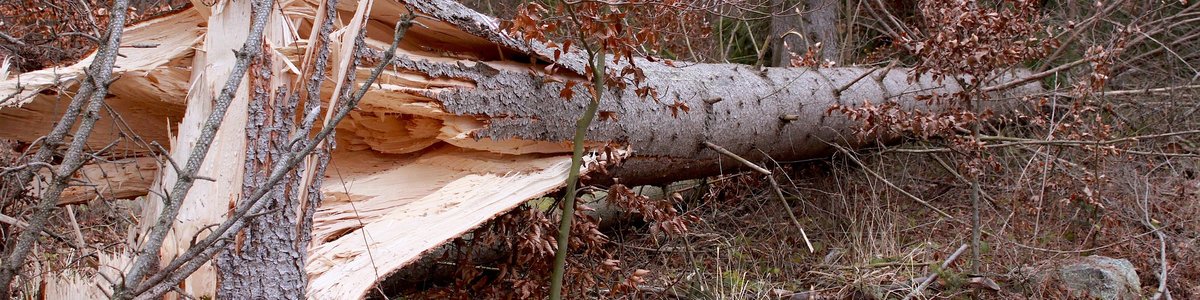
Over the summer several of our Research Software Engineers (RSEs), Scott Archer-Nicholls, Douglas Lowe and Francisco Herrerias Azcue, collaborated with Professor David Schultz from the Centre for Atmospheric Science in the Department of Earth and Environmental Sciences to run a summer research internship program. Five undergraduate students from environmental sciences (ranging from first to third years) spent their summer learning how weather forecasting computer models work, developing research skills and gaining real-world experience analysing advanced weather simulations of strong low-pressure systems that produced damaging winds and electrical power outages.
The RSE team has previously worked with David both on meteorology research projects (more on these below), as well as in delivering Natural Environment Research Council (NERC)-funded training in software development for environmental-sciences researchers. Leftover project funds were put to good use to run these research internships with planning starting in March 2026 with a meeting with Doug on how to deliver the best experience for the students.
Preparation for the Internship
Work on the summer research internship began in April, with Scott running three high-resolution simulations of past weather events on the University’s central high-performance computing resource: two windstorms in Europe and one in North America. All three of these storms produced strong winds, caused extended power outages over wide regions, and had devastating impacts on people in the regions affected. Better understanding of how such storms develop is needed for predicting their impacts in the future, which is essential for protecting our energy infrastructure as we move towards net zero.
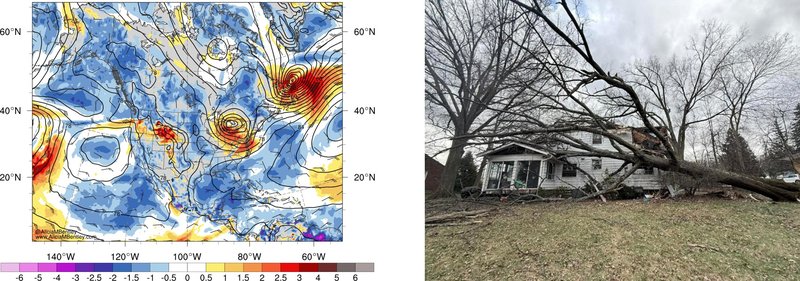
The simulations were produced using the Weather Research and Forecasting (WRF) model – a community model for making weather forecasts and studying atmospheric processes, a model that both Doug and Scott had used before. The WRF data created for this internship will also be shared with collaborators in the School of Engineering who are researching electrical-grid resilience and ocean-wave generation.
The students carried out their data analysis on the MaSC Portal, a dedicated service for undergraduate teaching in computation hosted by the Modelling and Simulation Centre (MaSC) in the department of Mechanical and Aeronautical Engineering (MAE). The Portal was set up by Research Software Engineer Ian Hinder as part of a long-running RSE project with Prof Alistair Revell in MAE, using servers purchased and run through the RIT Edge Compute service. The MaSC Portal is accessed through a web-based Jupyter Lab interface, backed by a small computing cluster to provide students with the experience of working on a High-Performance Computing (HPC) system.
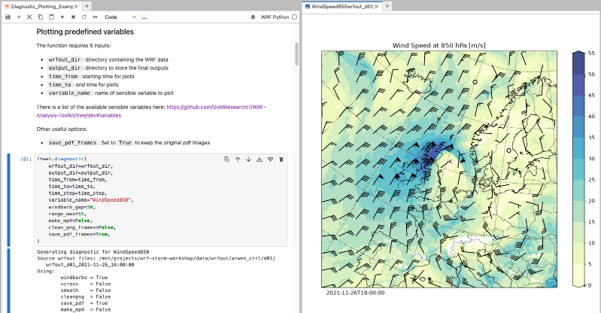
Francisco had previously created plotting and analysis tools for working with WRF data for the Spanish Plume project. These consisted of Python tools, built on the wrf-python package, and shell scripts for the 20-year-old, Fortran-based, RIP tool, which Francisco containerised so that it could be used easily on modern HPC systems. These tools were adapted by Francisco and Scott for this project to create the WRF-Analysis Toolkit package – now a publicly available resource for producing visualisations and diagnostics of WRF data. The package was installed using micromamba and apptainer on the MaSC Portal, enabling the students to access these tools directly within their Jupyter notebooks.
Summer Internship Itinerary
The internship began with an intense summer school at the start of July, consisting of a series of lectures and training sessions. David gave the students lessons in weather forecasting science and research techniques. The RSEs followed with a series of workshops on the WRF model (based on the NCAR WRF tutorials), using Python and RIP for WRF data analysis, software version control, and working on HPC systems. During these workshops, the RSE team also provided example Jupyter notebooks to the students, demonstrating how these tools could be used.
Over the rest of July and August, the students conducted independent research into the storms, with continued scientific support from David and technical support from the RSEs. The internship ended with the students giving presentations of their findings to each other, submitting reports of their research results and having a pizza party!
Fruits of Collaboration
Preparing an advanced research internship and summer school with such a short turnaround was only possible because of years of collaboration between Research IT, Atmospheric Science, and the School of Engineering. The availability of the CSF3 facility meant we could run computationally expensive, research-quality simulations, while Research Data Storage facilities allowed us to store and share the large data produced.
The previous experience that Doug, Scott and Francisco had working with the Centre for Atmospheric Science and in delivering computation training for the University meant we could deliver advanced teaching on weather models and their analysis at short notice. The MaSC Portal provided a dedicated computational resource with fast turnaround and a high level of customisability. Using a custom Python package installed on the Portal meant students could analyse data in a controlled environment without the problems of installing software that typically plague newcomers to the field.
Collectively, these efforts streamlined the experience for the students. New PhD students in atmospheric science typically spend the bulk of their first year getting to the stage where they can start looking at meteorological model data; these students were able to hit the ground running analysing data from day one.
When I was a research scientist early in my career, I was a mentor in an NSF-funded undergraduate summer research experience program. Students would come to Oklahoma, work on research for ten weeks, write up and present their research, and then go back to their undergraduate universities. It was this program that showed me the potential for research to transform student enthusiasm for their subject. Students got practical experience in the kinds of things that they were learning in lectures. Plus, they got to experience the world of research and explore whether research was something they were interested in pursuing. I wanted to give students that same opportunity here in Manchester. The students exceeded my expectations, and I look forward to working with them to publish their research projects
The summer internship was a really valuable experience that helped me build my research and technical skills, particularly through working with WRF and Python. The support from Scott, Doug, and Francisco on the technical side, especially with the modelling setup and troubleshooting, made the project much easier to carry out and allowed me to focus more on the research itself.
This internship has been such a brilliant hands-on introduction to research computing, going from raw WRF model output all the way through to trajectory analysis and a full research presentation in just a few weeks was genuinely exciting, and something I couldn’t have done without the toolkit and the support behind it. I’ve come away with skills I’ll be using well beyond this project.
Acknowledgements
Thanks to the MaSC Portal team: Ian Hinder, Alistair Revell, Saleh Rezaeiravesh, Alex Skillen, Dania Ahmed, Jundi He, Ajay Bangalore Harish.
The authors would like to acknowledge the assistance given by Research Infrastructure and the use of the Computational Shared Facility at The University of Manchester. Also, thanks to the Edge Compute team for support in setting up the MaSC Portal: Goar Sanchez Sanz and Paul Mulherrin.
This project was possible due to funding from the Natural Environment Research Council NE/W000997/1 to David Schultz at the University of Manchester.